
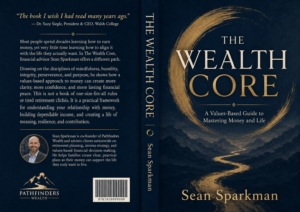
Sean Sparkman’s “The Wealth Core” challenges just about everything you think you know about how money really works.
By Tammy de Leeuw
As it has done with so many aspects of life, America has turned financial advice into a spectator sport.
We’ve got millionaire gurus selling their so-called wealth secrets, retirement influencers predicting economic Armageddon at any moment, and so much conflicting investment advice floating around that your head may feel close to exploding.
Yet despite access to a never-ending stream of information and advice, millions of Americans continue to lie awake at night worrying about money.
You have to wonder…”What are we missing?”
Sean Sparkman, author of The Wealth Core: A Values-Based Guide to Mastering Money and Life, says the answer may have less to do with what’s in our bank accounts than what’s going on between our ears.
Before you roll your eyes at the thought of another book about mindset, positive thinking, or spiritual enlightenment, hear me out.
Sparkman isn’t suggesting that you can meditate your way to a seven-figure portfolio or manifest a comfortable retirement by speaking positive affirmations to your investment app.
Instead, The Wealth Core makes a considerably more compelling argument: You can learn every financial strategy in the world, but if you haven’t mastered yourself, you may never master your money.
Sean draws upon his extensive experience in martial arts, where success demands considerably more than just physical strength. A successful martial artist needs discipline, patience, humility, focus, and the ability to remain calm when everything around you seems determined to knock you flat on your backside.
A peaceful and prosperous financial life requires the same.
Markets crash. Jobs disappear. Unexpected expenses arrive that can upend the most meticulous plans. Even when things are going reasonably well, some human beings demonstrate a remarkable talent for sabotaging their own financial security. They may not even realize what is driving these disastrous money decisions. Sadly, they may discover that they do not have enough time to recover from these mistakes.
But, there’s good news, says Sean Sparkman. If you want to achieve your money goals, you might begin by simply understanding what you truly value.
Not what your neighbors value. Not what social media tells you to value. Not what some financial entertainer tells you. You should have clarity about what matters to YOU.
After all, what’s the point of accumulating a small fortune if you’re too anxious, exhausted, or distracted to enjoy the life it’s supposed to provide?

In The Wealth Core, Sparkman encourages readers to gain perspective about the things they value, and to explore qualities such as mindfulness and humility, two concepts that rarely, if ever, escape the lips of conventional financial planners.
Mindfulness, says Sean, encourages us to recognize why we’re making financial decisions rather than operating on emotional autopilot. Humility can remind us that being successful, educated, or financially sophisticated doesn’t make us immune to making spectacularly stupid money mistakes.
In my opinion, Wall Street could probably use a little more of both.
Now, let’s be clear about something. Developing a wealth core mindset isn’t a substitute for having a basic understanding of investments, managing debt, or developing a sensible retirement strategy. Rather, a wealth core strategy complements and enhances that knowledge. Effective financial planners know that good intentions, mindset and meditation alone won’t pay the bills. However, the savviest holistic planners understand the relationships between these concepts and how to integrate them into an effective retirement blueprint.
But Sparkman’s central argument deserves serious consideration: A financial plan is only as effective as the person responsible for following it.
Perhaps ignoring this truth is why so much conventional financial advice falls short. It concentrates on the mechanics of money while overlooking the complicated, emotional, and occasionally irrational human behind the decisions.
The Wealth Core asks us to consider something beyond the usual question of how much money we think we need. It asks us to consider what we want that money to accomplish.
I found The Wealth Core refreshing precisely because Sparkman doesn’t pretend that building wealth is merely a mathematical exercise. It’s also a matter of character, priorities, and behavior.
While it’s true that no book can guarantee financial freedom, this one offers an intriguing place to begin: with an honest examination of the person looking back at you in the mirror.
Because sometimes the biggest obstacle standing between you and financial peace isn’t the economy, the stock market, or your paycheck. Sometimes it’s you, and that’s something you might actually be able to change.
Ready to Discover Your Wealth Core?
Before you buy another financial book promising to reveal the secrets of the wealthy, let me suggest you try something different.
DOWNLOAD YOUR FREE EXCERPT OF THE WEALTH CORE
No crystal balls. No get-rich-quick nonsense. Just a fresh perspective on money, life, and what it really means to be wealthy.