by Sean Sparkman
You’ve probably heard it before:
“Just buy the market and you’ll be diversified.”
Sounds simple. Sounds safe.
But, there’s a problem. That statement isn’t as true today as it used to be.
Right now, a small group of companies that some financial pundits call “The Magnificent Seven” is doing most of the heavy lifting in the stock market. And although that’s been great for returns, it’s also quietly created a risk many investors don’t see. This is not because these investors are careless, but because the risk remains hidden in plain sight.
Has diversification become an illusion?
Let me ask you this: If it’s true that a mere handful of stocks are driving a large portion of market performance, are you really diversified?
Today, the top 10 companies make up close to 40% of the S&P 500. That’s a level of concentration we don’t see very often.
Such concentration means that even if you own an index fund, a vehicle that feels broadly diversified, your results may still depend heavily on just a few names.
That’s not necessarily wrong. However, it is something you should understand because concentration works both ways.
Let’s take a peek at the data.
The concentration issue gets more interesting when you pull back the curtains on the actual data as illustrated in this chart.
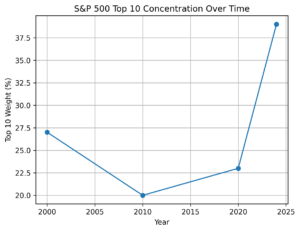
What you’re looking at:
The growing percentage of the S&P 500 represented by its largest companies over time.
The takeaway:
We’ve moved from a broadly distributed market to one where performance is increasingly concentrated.
Reality check:
If a large portion of your portfolio rises and falls with a handful of stocks…
you don’t have broad diversification. You now have a concentrated bet.
(Source inspiration: Morningstar, Charles Schwab)
This matters a lot more than you might think.
To be fair, the Magnificent Seven are great companies with profits driven by innovation. But that’s not the issue. The problem is what happens when everyone piles into the same trade.
- Expectations are elevated
When valuations climb, it’s no longer enough for companies to perform well. They are now obliged to outperform expectations. As you might imagine, that’s a much more challenging feat.
- Small Disappointments Get Punished
You’ve probably already seen this happen. A strong earnings report is issued. But then there is a stock drop. Why? Because the earnings report was not strong enough.
- The market becomes fragile
When market leadership is limited, the entire market can wobble if those leaders stumble. It’s a bit like building a house on a few very strong pillars. Everything’s fine until one of the pillars cracks.
What most investors miss
Here’s a subtle danger that most investors overlook…
You don’t have to intentionally concentrate your portfolio for it to become concentrated.
Concentration can happen automatically. For instance, if you own:
- Index funds
- Growth-heavy portfolios
- Large-cap ETFs
you may already be more exposed than you realize.
And that’s what makes this risk so tricky to manage. It doesn’t feel like risk.
Is there an alternative?
Let’s be clear, this isn’t about avoiding successful companies.
It’s about not depending on them.
Because history has a funny way of reminding investors of one simple truth:
Leadership rotates.
What dominates one decade often takes a back seat in the next.
What does true diversification actually look like?
Real diversification isn’t just about owning more stocks.
It’s about owning different drivers of return.
Such drivers may include:
- Large, mid, and small companies
- U.S. and international markets
- Different sectors (not just tech)
- A mix of asset types—not just equities
Because different environments reward different assets.
And you don’t get to choose the environment…
Only how prepared you are for it.
A simple way to think about it
There are two ways to build a portfolio:
Option A:
Bet on what’s working right now.
Option B:
Prepare for what might work next.
Most investors naturally drift toward Option A.
Disciplined investors build around Option B.
The Bottom Line
The “Magnificent Seven” may continue to lead.
They may even outperform for years.
But that’s not the point.
The point is this:
If your financial future depends heavily on a small group of stocks—
you’re taking a risk, whether you intended to or not.
Diversification doesn’t guarantee better returns.
But it does something far more important:
It reduces the chance that one narrow outcome determines everything.
And in the long run…
That’s a trade-off most investors are glad they made.

This article is for informational purposes only and should not be considered financial, tax, or investment advice. Always consult with a qualified financial professional before making investment decisions.